Women's Clothing in Ancient China
Ancient Chinese clothing is a family of its own in the world, its structures and styles gradually have changed with the developments of living and producing style.
As early as the Shang and Zhou Dynasties, both the superior and the inferior, men and women all adopted the upper and lower two-segment system, with “yi”, the clothes on the top and “chang”, the clothes on the bottom. And the word “yi shang” came from this. Over time, tops and bottoms remained the mainstream, and their styles remained the same. It’s just that the sleeves are getting bigger and bigger, forming a style with large sleeves. Clothes gradually became wider, and clothing became a symbol of one’s class.
During the Spring and Autumn Period and the Warring States Period, deep-coat robes became popular. Most of the deep clothes are silk fabrics and long coats with large sleeves, the most prominent dress, and the deep coat must be tightly wrapped around the waist.
The Qin and Han Dynasties followed the deep-clothed “Ruqun” which was born during the Spring and Autumn Period and the Warring States Period. The deep-clothed robe was a kind of straight-barreled long shirt with a crossed collar. The clothes and clothes were cut separately, but sewn together when they were ready. From the pre-Qin Dynasty to the Eastern Han Dynasty, the style of deep clothes became narrower and narrower, and the straight skirt slowly replaced the complex curved skirt. At this time, the tops and bottoms are still the basic styles.
During the Wei and Jin Dynasties, the liberation of self-personality began to be emphasized, and women’s clothing generally inherited the Hanfu style, integrating many ethnic minority clothing elements to form its own characteristics, such as: plackets, corsets, wide sleeves with some contrasting edges on the cuffs, plackets, hems, and the skirt which became a pleated skirt. Long skirts and large sleeves flutter to express elegance and flowing natural style.
In the Sui and early Tang Dynasties, the silhouette of women’s clothing was slender and straight, mainly with short sleeves, tight-fitting long skirts, and high bunches. Silk was popular to show the beauty. In the Tang Dynasty, women’s silhouettes were wide and fat, and the skirts were long and dragged to the ground, in order to show the beauty of grace, luxury and wealth. By the late Tang Dynasty, the silhouette of women’s clothing was still mainly fat, but the overall shape was like a hanging bell, which could show the beauty of solemnity better.
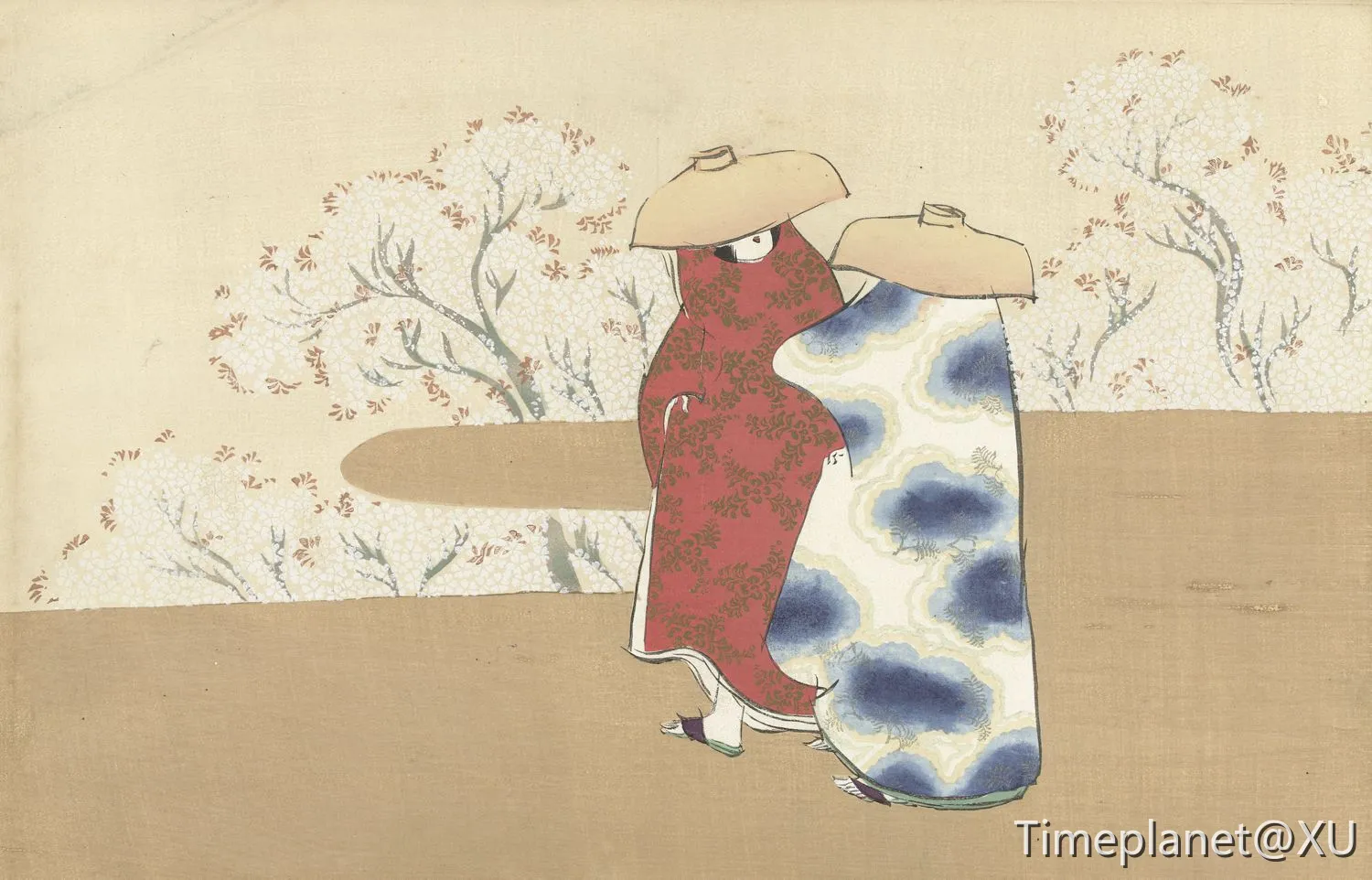
During the Five Dynasties period, the clothing began to revert to the basic style of Hanfu. It is popular for people to wear narrow-sleeved shirts, flower long skirts, narrow silk scarves, and a jade pendent called “jin bu” which regulate the way they walk. This costume was maintained until the Ming and Qing dynasties.
Narrow, thin, long and novel are the main characteristics of women’s clothing in the Song Dynasty. Beizi, women’s common clothing from the Song Dynasty to the Ming Dynasty, is the style of straight collar placket, slitting in the armpit crotch, waist being tied with a silk downing over the knee. It derived from “half arm” in the Sui and Tang Dynasties. It gradually became a kind of dress for women in later generations.
The class differences of women’s clothing in the Yuan Dynasty is more obvious, and the Han women’s clothing generally follows the style of the Song Dynasty, mainly with a cross-necked and right-sided shirt with large or narrow sleeves. And they often wear a narrow-sleeved long gown, a pleated skirt underneath, trousers inside, and shallow bottom shoes.
Most of the clothing styles of the Ming Dynasty were imitated from which of the Tang and Song Dynasties, and on the original basis, XiaPei, Bijia, and ShuiTianYi have been created. Women’s main costumes were Beizi, Bijia and skirts. Beizi has wide or narrow sleeve. Narrow-sleeved Beizi has lace on the cuffs and collars. But the collar lace is only to the chest, the wide-sleeved Beizi only has lace on the placket, and the collar goes all the way until the hem. Shaped like a Beizi and without sleeves, Bijia is prevalently worn by young women in the middle of the Ming Dynasty.
In the early Qing Dynasty, women’s clothing was a long coat with a round neck, right lapel, flat sleeves, slitting in the front and back, which were later changed into slitting from left and right to the armpits. And the top of the slits must be decorated with cloud patterns. The pattern of the cheongsam is more gorgeous, and the edges are more exquisite and meaningful. Today’s most familiar cheongsam rose from here, but most of the cheongsam in the Qing Dynasty have a round neck, and the buttons are all on the right side, often five. It was not until the period of the Republic of China that the cheongsam was changed to a slim style.
From the simple animal skin clothes that were used only to protect the body from the cold in the time of the cavemen in Beijing, to the exquisite costumes of the Qing Dynasty, ancient Chinese costumes have undergone a long process of development. It’s a part of the traditional Chinese culture and a precious treasure of the Chinese nation. The evolution of clothing is a history worn on the body. The change of clothing trends is a reflection of the social landscape of each dynasty and the result of the dialogue between its symbolic and practical function. The clothing of each dynasty has its own characteristics, and at the same time has a common connotation. Ancient Chinese costumes demonstrate the eternal charm of traditional Chinese civilization.